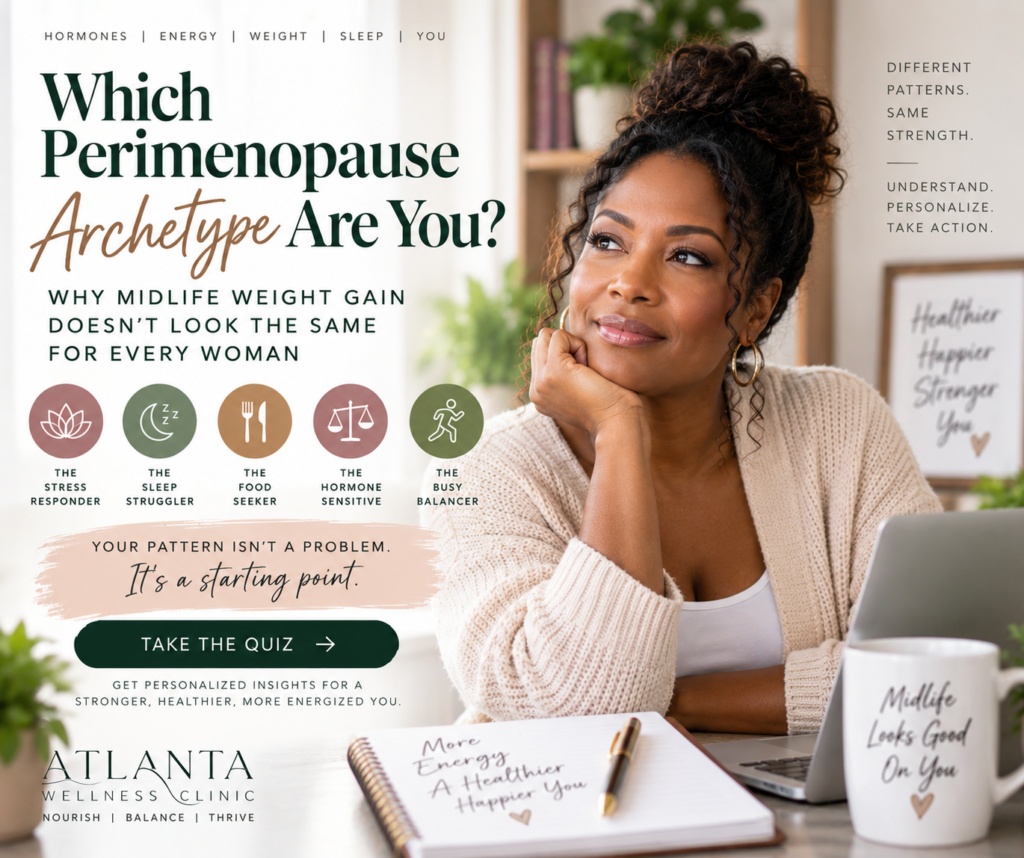
Which Perimenopause Archetype Are You?
You turned 40-something and suddenly your body stopped following the rules.
The workouts that used to work don’t seem to do much. Weight starts collecting around your middle. You wake up at 3 a.m. You’re exhausted at 3 p.m. One week you’re craving everything in the pantry. The next week you barely have an appetite.
And perhaps you’ve wondered: “Is this perimenopause—or is something else going on?”
For many women, midlife brings together multiple changes at once. Hormones fluctuate. Sleep changes. Stress accumulates. Muscle mass can decline. Body composition can shift. And the lifestyle that worked beautifully at 32 may no longer serve you at 47.
But there’s another important point: perimenopause doesn’t look the same for every woman.
That’s why Atlanta Wellness Clinic created our Perimenopause Archetype Quiz, now part of our broader Midlife Wellness approach.
Why We Created Archetypes
Two women can both say, “I can’t lose weight,” while the patterns behind their experiences look completely different.
One woman may be sleeping five hours a night, operating under enormous stress, and craving sugar every afternoon. Another may eat relatively well but struggle with low energy and reduced activity. Another may feel like digestion and inflammation are constantly working against her.
If we give all three women exactly the same plan, we’re ignoring the information that could help us personalize their support.
Our archetypes give us a starting point for the conversation. They are not medical diagnoses. They are not labels that define you. They’re patterns designed to help us ask better questions.
Your Body Is Giving You Clues
The afternoon crash is information. The 3 a.m. wake-up is information. The constant cravings are information. The feeling that you’re “doing everything right” but not seeing progress is information.
Instead of judging those experiences, we can become curious about them. That’s a completely different way to approach wellness.
From Quiz Result to Personalized Strategy
Taking the quiz is only the beginning. What makes it useful is what we do with the information.
Your results can help guide conversations about nutrition, stress, sleep, movement, recovery, weight-management goals, hormone-related concerns, and whether additional medical evaluation may be appropriate.
For example, a woman whose responses suggest that stress and poor recovery dominate her experience probably doesn’t need someone immediately telling her to exercise harder and eat less. Her first 1% change might be sleep consistency, a daily stress-reset routine, a nutrition review, or a conversation with a licensed medical provider if symptoms warrant one.
Perimenopause Isn’t Just About Weight
Weight gain may be what gets your attention, but many women tell us that what bothers them most is how they feel. They miss their energy, patience, confidence, sleep, and mental clarity.
That’s why our approach isn’t simply “How do we make the scale go down?” We’re asking: “How do we help you feel stronger, healthier, calmer, and more in control of your wellness?”
Where Hormone Optimization Fits
For some women, symptoms may warrant a conversation with a qualified medical provider. That’s where our telehealth platform becomes another part of the wellness ecosystem.
Rather than guessing whether your symptoms are “just age,” you can discuss your concerns with a licensed provider who can determine whether medical evaluation, laboratory testing, or treatment options are appropriate.
Lifestyle still matters. Nutrition still matters. Stress still matters. Sleep still matters. Medical care doesn’t replace those foundations, and lifestyle coaching doesn’t replace medical care. They can complement one another.
Start by Understanding Your Pattern
You don’t need to diagnose yourself from social media, and you don’t need to assume every symptom is something you simply have to tolerate because you’re getting older.
Start with awareness. Take the Midlife Wellness / Perimenopause Archetype Quiz. Then use the results as a starting point for a more personalized wellness strategy.
Midlife isn’t a problem to solve. But it is a transition worth understanding. Your body is changing. Your strategy can change with it.